
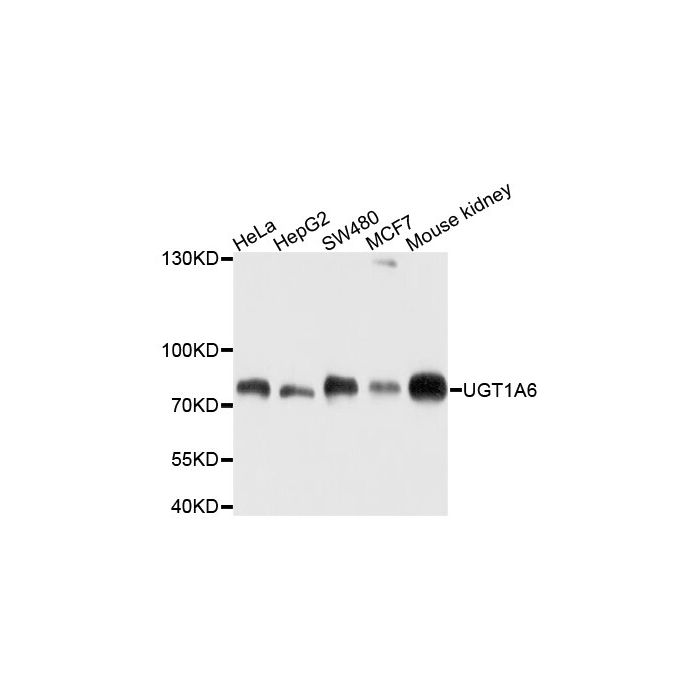
UGT1A6 polyclonal, anti-human, mouse, rat
€388.00
In stock
SKU
BS70253
Background:
The human UDP-glucuronosyltransferase 1 (UGT1) locus encodes at least ten UGT1A proteins (UGT1A1-UGT1A10) that play a prominent role in drug and xenobiotic metabolism. Research indicates that nuclear receptors such as pregnane X receptor (PXR), constitutive androstane receptor (CAR) and peroxisome proliferator-activated receptor (PPAR) can regulate UGTs, which may contribute to the tissue-specific expression pattern of UGTs. Deficiency in the expression and/or activity of UGTs may lead to genetic and acquired diseases such as Crigler-Najjar syndrome and Gilbert syndrome. Based on their ability to catalyze the glucuronidation of xenobiotics and endobiotics, UGTs play a critical role in hormonal homeostasis, energy metabolism, bilirubin clearance and xenobiotic detoxification.
Alternative Name:
UDP-glucuronosyltransferase 1-6, UDPGT 1-6, UGT1*6, UGT1-06, UGT1.6, UDP-glucuronosyltransferase 1-F, UGT-1F, UGT1F, UGT1A6, GNT1, UGT1
Application Dilution: WB: 1:500 - 1:1000, IHC: 1:50 - 1:100
Specificity: UGT1A6 polyclonal antibody detects endogenous levels of UGT1A6 protein.
Immunogen:
Recombinant protein of human UGT1A6.
MW: ~ 61 kDa
Swis Prot.: P19224
Purification & Purity:
The antibody was affinity-purified from rabbit antiserum by affinity-chromatography using epitope-specific immunogen and the purity is > 95% (by SDS-PAGE).
Format:
1mg/ml in PBS with 0.02% sodium azide, 50% glycerol, pH7.3.
Storage:
Store at 4°C short term. Aliquot and store at -20°C long term. Avoid freeze-thaw cycles.
For research use only, not for use in diagnostic procedure.
The human UDP-glucuronosyltransferase 1 (UGT1) locus encodes at least ten UGT1A proteins (UGT1A1-UGT1A10) that play a prominent role in drug and xenobiotic metabolism. Research indicates that nuclear receptors such as pregnane X receptor (PXR), constitutive androstane receptor (CAR) and peroxisome proliferator-activated receptor (PPAR) can regulate UGTs, which may contribute to the tissue-specific expression pattern of UGTs. Deficiency in the expression and/or activity of UGTs may lead to genetic and acquired diseases such as Crigler-Najjar syndrome and Gilbert syndrome. Based on their ability to catalyze the glucuronidation of xenobiotics and endobiotics, UGTs play a critical role in hormonal homeostasis, energy metabolism, bilirubin clearance and xenobiotic detoxification.
Alternative Name:
UDP-glucuronosyltransferase 1-6, UDPGT 1-6, UGT1*6, UGT1-06, UGT1.6, UDP-glucuronosyltransferase 1-F, UGT-1F, UGT1F, UGT1A6, GNT1, UGT1
Application Dilution: WB: 1:500 - 1:1000, IHC: 1:50 - 1:100
Specificity: UGT1A6 polyclonal antibody detects endogenous levels of UGT1A6 protein.
Immunogen:
Recombinant protein of human UGT1A6.
MW: ~ 61 kDa
Swis Prot.: P19224
Purification & Purity:
The antibody was affinity-purified from rabbit antiserum by affinity-chromatography using epitope-specific immunogen and the purity is > 95% (by SDS-PAGE).
Format:
1mg/ml in PBS with 0.02% sodium azide, 50% glycerol, pH7.3.
Storage:
Store at 4°C short term. Aliquot and store at -20°C long term. Avoid freeze-thaw cycles.
For research use only, not for use in diagnostic procedure.
| Is Featured? | No |
|---|
Write Your Own Review