
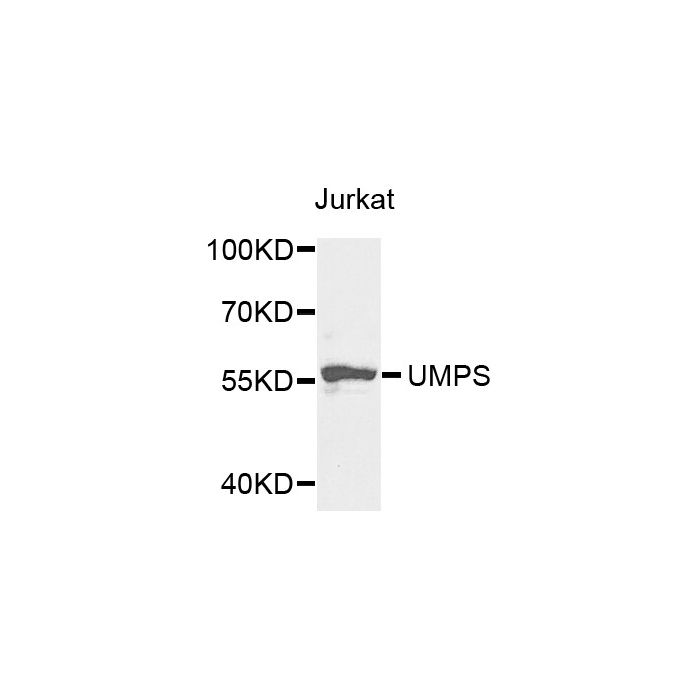
UMPS polyclonal, anti-human, mouse, rat
€388.00
In stock
SKU
BS7790
Background:
Uridine 5'-monophosphate synthase (UMPS) catalyzes the last two steps of the pyrimidine biosynthetic pathway. Unlike prokaryotes, UMPS in eukaryotes combines the orotate phosphoribosyltransferase and the orotidine-5’-monophosphate (OMP) decarboxylase activities into a single protein. The union of these two enzymes is thought to stabilize the catalytic centers due to the low molar concentration of the protein in mammalian cells. Loss of either enzymatic activity results in hereditary orotic aciduria, a rare autosomal recessive disorder characterized by retarded growth, anemia, and excessive urinary excretion of orotic acid. Two isoforms of UMPS exist as a result of alternative splicing events.
Alternative Name:
ODC, OMPdecase, OPRT, OPRTase, Orotate phosphoribosyl transferase and orotidine 5' decarboxylase, Orotate phosphoribosyltransferase, Orotate phosphoribosyltransferase phosphoribosyltransferase, Orotidine 5' phosphate decarboxylase, Orotidine 5''-phosphate decarboxylase, RP11-71H17.9, UMP synthase, Umps, UMPS_HUMAN, Uridine 5' monophosphate synthase, Uridine monophosphate synthetase,
Application Dilution: WB: 1:500~1:2000, IHC/IF: 1:50~1:200
Specificity: UMPS polyclonal antibody detects endogenous levels of UMPS protein.
Immunogen:
Recombinant full length Human UMPS.
MW: ~ 52 kDa
Swis Prot.: P11172
Purification & Purity:
The antibody was affinity-purified from rabbit antiserum by affinity-chromatography using epitope-specific immunogen and the purity is > 95% (by SDS-PAGE).
Format:
1mg/ml in PBS with 0.1% Sodium Azide, 50% Glycerol.
Storage:
Store at 4°C short term. Aliquot and store at -20°C long term. Avoid freeze-thaw cycles.
For research use only, not for use in diagnostic procedure.
Uridine 5'-monophosphate synthase (UMPS) catalyzes the last two steps of the pyrimidine biosynthetic pathway. Unlike prokaryotes, UMPS in eukaryotes combines the orotate phosphoribosyltransferase and the orotidine-5’-monophosphate (OMP) decarboxylase activities into a single protein. The union of these two enzymes is thought to stabilize the catalytic centers due to the low molar concentration of the protein in mammalian cells. Loss of either enzymatic activity results in hereditary orotic aciduria, a rare autosomal recessive disorder characterized by retarded growth, anemia, and excessive urinary excretion of orotic acid. Two isoforms of UMPS exist as a result of alternative splicing events.
Alternative Name:
ODC, OMPdecase, OPRT, OPRTase, Orotate phosphoribosyl transferase and orotidine 5' decarboxylase, Orotate phosphoribosyltransferase, Orotate phosphoribosyltransferase phosphoribosyltransferase, Orotidine 5' phosphate decarboxylase, Orotidine 5''-phosphate decarboxylase, RP11-71H17.9, UMP synthase, Umps, UMPS_HUMAN, Uridine 5' monophosphate synthase, Uridine monophosphate synthetase,
Application Dilution: WB: 1:500~1:2000, IHC/IF: 1:50~1:200
Specificity: UMPS polyclonal antibody detects endogenous levels of UMPS protein.
Immunogen:
Recombinant full length Human UMPS.
MW: ~ 52 kDa
Swis Prot.: P11172
Purification & Purity:
The antibody was affinity-purified from rabbit antiserum by affinity-chromatography using epitope-specific immunogen and the purity is > 95% (by SDS-PAGE).
Format:
1mg/ml in PBS with 0.1% Sodium Azide, 50% Glycerol.
Storage:
Store at 4°C short term. Aliquot and store at -20°C long term. Avoid freeze-thaw cycles.
For research use only, not for use in diagnostic procedure.
| Is Featured? | No |
|---|
Write Your Own Review