
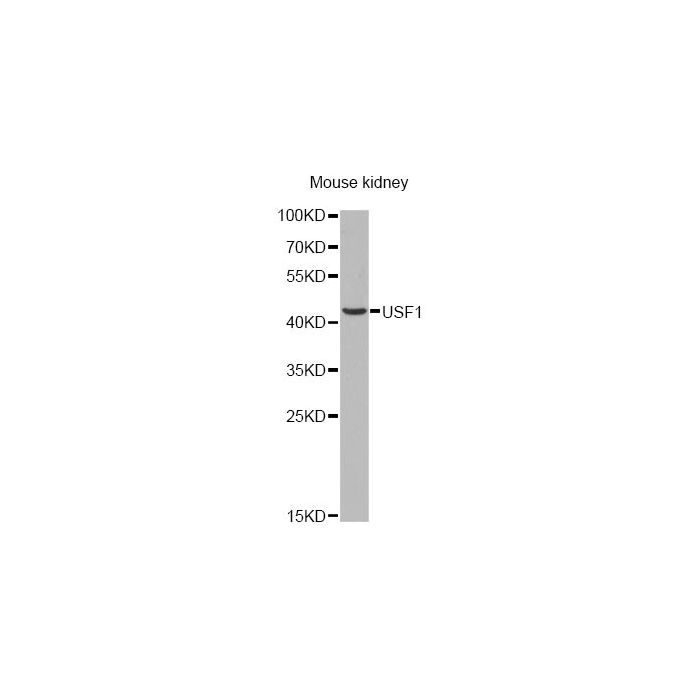
USF1 polyclonal, anti-human, mouse
€388.00
In stock
SKU
BS6759
Background:
The ubiquitously expressed cellular upstream stimulatory factor (USF) consists of (USF-1) and (USF-2) polypeptides which independently exhibit site-specific DNA binding and are members of the c-Myc-related family of regulatory factors containing helix-loop-helix domains. USF also contains a leucine repeat that is required for efficient DNA binding. USF was originally identified as an upstream stimulatory factor that binds the core sequence CACGTG in the adenovirus late promoter. These findings, together with the demonstration of cooperative interaction between USF and the initiator-binding protein, TFII-I, raises the possibility of a more general involvement of USF in transcriptional regulation. While expression of both USF-1 and USF-2 species is ubiquitous, different ratios of USF homo- and heterodimers are found in different cell types.
Alternative Name:
bHLHb11, Class B basic helix-loop-helix protein 11, FCHL 1, FCHL, FCHL1, HGNC:12593, HYPLIP 1, HYPLIP1, Major late transcription factor 1, Major late transcription factor, MLTF, MLTF I, MLTFI, Transcription factor USF-1, UEF, Upstream stimulatory factor 1, Upstream transcription factor 1, Upstream transcription factor 1, isoform CRA_a, USF 1, USF,
Application Dilution: WB: 1:500~1:2000, IHC: 1:50~1:200
Specificity: USF1 polyclonal antibody detects endogenous levels of USF1 protein.
Immunogen:
Recombinant full length Human USF1.
MW: ~ 34 kDa
Swis Prot.: P22415
Purification & Purity:
The antibody was affinity-purified from rabbit antiserum by affinity-chromatography using epitope-specific immunogen and the purity is > 95% (by SDS-PAGE).
Format:
1mg/ml in PBS with 0.1% Sodium Azide, 50% Glycerol.
Storage:
Store at 4°C short term. Aliquot and store at -20°C long term. Avoid freeze-thaw cycles.
For research use only, not for use in diagnostic procedure.
The ubiquitously expressed cellular upstream stimulatory factor (USF) consists of (USF-1) and (USF-2) polypeptides which independently exhibit site-specific DNA binding and are members of the c-Myc-related family of regulatory factors containing helix-loop-helix domains. USF also contains a leucine repeat that is required for efficient DNA binding. USF was originally identified as an upstream stimulatory factor that binds the core sequence CACGTG in the adenovirus late promoter. These findings, together with the demonstration of cooperative interaction between USF and the initiator-binding protein, TFII-I, raises the possibility of a more general involvement of USF in transcriptional regulation. While expression of both USF-1 and USF-2 species is ubiquitous, different ratios of USF homo- and heterodimers are found in different cell types.
Alternative Name:
bHLHb11, Class B basic helix-loop-helix protein 11, FCHL 1, FCHL, FCHL1, HGNC:12593, HYPLIP 1, HYPLIP1, Major late transcription factor 1, Major late transcription factor, MLTF, MLTF I, MLTFI, Transcription factor USF-1, UEF, Upstream stimulatory factor 1, Upstream transcription factor 1, Upstream transcription factor 1, isoform CRA_a, USF 1, USF,
Application Dilution: WB: 1:500~1:2000, IHC: 1:50~1:200
Specificity: USF1 polyclonal antibody detects endogenous levels of USF1 protein.
Immunogen:
Recombinant full length Human USF1.
MW: ~ 34 kDa
Swis Prot.: P22415
Purification & Purity:
The antibody was affinity-purified from rabbit antiserum by affinity-chromatography using epitope-specific immunogen and the purity is > 95% (by SDS-PAGE).
Format:
1mg/ml in PBS with 0.1% Sodium Azide, 50% Glycerol.
Storage:
Store at 4°C short term. Aliquot and store at -20°C long term. Avoid freeze-thaw cycles.
For research use only, not for use in diagnostic procedure.
| Is Featured? | No |
|---|
Write Your Own Review