
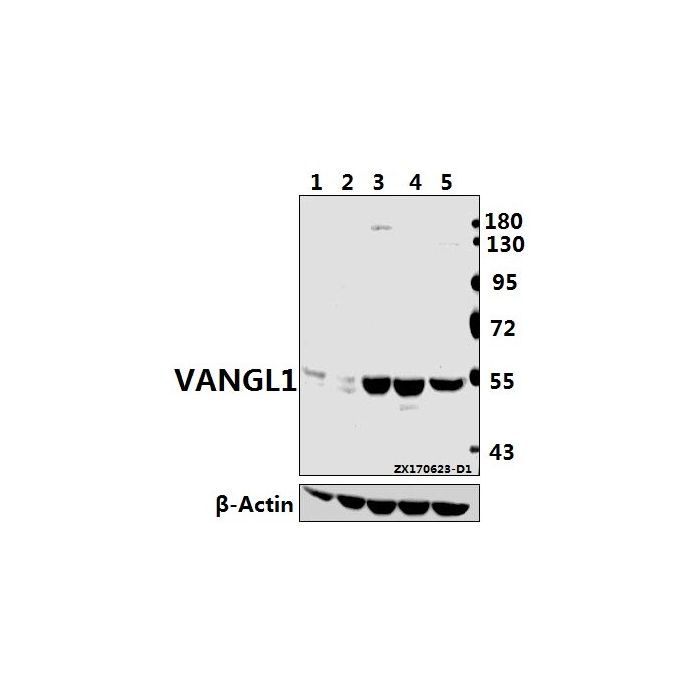
VANGL1 polyclonal, anti-human, mouse, rat
€305.00
In stock
SKU
BS61737
Background:
Van Gogh-like proteins (VANGL1, VANGL2) are human orthologs of Drosophila Van Gogh (Vang/Stbm), a multi-pass transmembrane protein that is required to establish cell polarity in embryonic eyes, legs, and bristles. As in Drosophila, mammalian VANGL proteins are core components of the planar cell polarity (PCP) pathway that promotes asymmetric orientation of cells across a planar surface, and drives convergence-extension movements that are critical for tissue morphogenesis. Mutations in the human VANGL1 gene have been identified in patients diagnosed with neural tube defects (e.g., spina bifida), providing evidence that VANGL1 plays a role in human embryonic morphogenesis. These findings are supported by genetic studies in mice, where mutations in both Vangl1 and Vangl2 result in neural tube defects. A possible role for VANGL in tumor progression is suggested by an increased expression of VANGL1 mRNA in breast cancer patients with an elevated risk of relapse.
Alternative Name:
Vang-like protein 1, Loop-tail protein 2 homolog, LPP2, Strabismus 2, Van Gogh-like protein 1, VANGL1, STB2
Application Dilution: WB: 1:500~1:1000
Specificity: VANGL1 polyclonal antibody detects endogenous levels of VANGL1 protein.
Immunogen:
Synthetic peptide, corresponding to amino acids 300-350 of Human VANGL1.
MW: ~ 60 kDa
Swis Prot.: Q8TAA9
Purification & Purity:
The antibody was affinity-purified from rabbit antiserum by affinity-chromatography using epitope-specific immunogen and the purity is > 95% (by SDS-PAGE).
Format:
1 mg/ml in Phosphate buffered saline (PBS) with 0.05% sodium azide, approx. pH 7.3.
Storage:
Store at 4°C short term. Aliquot and store at -20°C long term. Avoid freeze-thaw cycles.
For research use only, not for use in diagnostic procedure.
Van Gogh-like proteins (VANGL1, VANGL2) are human orthologs of Drosophila Van Gogh (Vang/Stbm), a multi-pass transmembrane protein that is required to establish cell polarity in embryonic eyes, legs, and bristles. As in Drosophila, mammalian VANGL proteins are core components of the planar cell polarity (PCP) pathway that promotes asymmetric orientation of cells across a planar surface, and drives convergence-extension movements that are critical for tissue morphogenesis. Mutations in the human VANGL1 gene have been identified in patients diagnosed with neural tube defects (e.g., spina bifida), providing evidence that VANGL1 plays a role in human embryonic morphogenesis. These findings are supported by genetic studies in mice, where mutations in both Vangl1 and Vangl2 result in neural tube defects. A possible role for VANGL in tumor progression is suggested by an increased expression of VANGL1 mRNA in breast cancer patients with an elevated risk of relapse.
Alternative Name:
Vang-like protein 1, Loop-tail protein 2 homolog, LPP2, Strabismus 2, Van Gogh-like protein 1, VANGL1, STB2
Application Dilution: WB: 1:500~1:1000
Specificity: VANGL1 polyclonal antibody detects endogenous levels of VANGL1 protein.
Immunogen:
Synthetic peptide, corresponding to amino acids 300-350 of Human VANGL1.
MW: ~ 60 kDa
Swis Prot.: Q8TAA9
Purification & Purity:
The antibody was affinity-purified from rabbit antiserum by affinity-chromatography using epitope-specific immunogen and the purity is > 95% (by SDS-PAGE).
Format:
1 mg/ml in Phosphate buffered saline (PBS) with 0.05% sodium azide, approx. pH 7.3.
Storage:
Store at 4°C short term. Aliquot and store at -20°C long term. Avoid freeze-thaw cycles.
For research use only, not for use in diagnostic procedure.
| Is Featured? | No |
|---|
Write Your Own Review