
VCP (A346) polyclonal, anti-human, mouse, rat
€305.00
In stock
SKU
BS3773
Background:
Valosin-containing protein (VCP or p97) belongs to the AAA (ATPase associated activities) family and acts as a molecular chaperone to a wide variety of cellular activities. Some of these activities include the alteration of both nuclear and mitotic golgi membranes, ubiquitin-proteasome dependent protein degradation, regulation of the NF-kappa b pathway, and extraction of membrane proteins. VCP has been shown to contain a substrate binding domain (N) and two conserved ATPase domains (D1 and D2). The three dimensional structure of VCP resembles that of a cylinder with the D1 and D2 stacked upon one another in a homo-hexameric ring formation. VCP is involved in the formation of neuronal inclusion bodies in neurodegenerative disease such as Parkinson's Disease.
Alternative Name:
15S Mg(2+) ATPase p97 subunit, ATPase p97, IBMPFD, MGC131997, MGC148092, MGC8560, TER ATPase, TERA, p97, transitional endoplasmic reticulum ATPase, valosin-containing protein, yeast Cdc48p homolog
Application Dilution: WB: 1:500~1:1000, IHC: 1:50~1:200
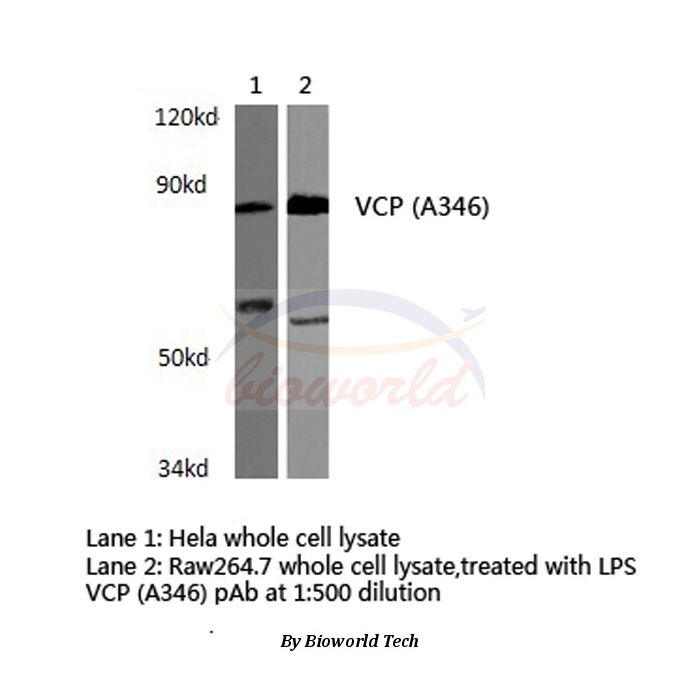
Specificity: VCP (A346) polyclonal antibody detects endogenous levels of VCP protein.
Immunogen:
Synthetic peptide, corresponding to amino acids 320-370 of Human VCP.
MW: ~ 88 kDa
Swis Prot.: P55072
Purification & Purity:
The antibody was affinity-purified from rabbit antiserum by affinity-chromatography using epitope-specific immunogen and the purity is > 95% (by SDS-PAGE).
Format:
1 mg/ml in Phosphate buffered saline (PBS) with 15 mM sodium azide, approx. pH 7.2.
Storage:
Store at 4°C short term. Aliquot and store at -20°C long term. Avoid freeze-thaw cycles.
For research use only, not for use in diagnostic procedure.
Valosin-containing protein (VCP or p97) belongs to the AAA (ATPase associated activities) family and acts as a molecular chaperone to a wide variety of cellular activities. Some of these activities include the alteration of both nuclear and mitotic golgi membranes, ubiquitin-proteasome dependent protein degradation, regulation of the NF-kappa b pathway, and extraction of membrane proteins. VCP has been shown to contain a substrate binding domain (N) and two conserved ATPase domains (D1 and D2). The three dimensional structure of VCP resembles that of a cylinder with the D1 and D2 stacked upon one another in a homo-hexameric ring formation. VCP is involved in the formation of neuronal inclusion bodies in neurodegenerative disease such as Parkinson's Disease.
Alternative Name:
15S Mg(2+) ATPase p97 subunit, ATPase p97, IBMPFD, MGC131997, MGC148092, MGC8560, TER ATPase, TERA, p97, transitional endoplasmic reticulum ATPase, valosin-containing protein, yeast Cdc48p homolog
Application Dilution: WB: 1:500~1:1000, IHC: 1:50~1:200
Specificity: VCP (A346) polyclonal antibody detects endogenous levels of VCP protein.
Immunogen:
Synthetic peptide, corresponding to amino acids 320-370 of Human VCP.
MW: ~ 88 kDa
Swis Prot.: P55072
Purification & Purity:
The antibody was affinity-purified from rabbit antiserum by affinity-chromatography using epitope-specific immunogen and the purity is > 95% (by SDS-PAGE).
Format:
1 mg/ml in Phosphate buffered saline (PBS) with 15 mM sodium azide, approx. pH 7.2.
Storage:
Store at 4°C short term. Aliquot and store at -20°C long term. Avoid freeze-thaw cycles.
For research use only, not for use in diagnostic procedure.
| Is Featured? | No |
|---|
Write Your Own Review