
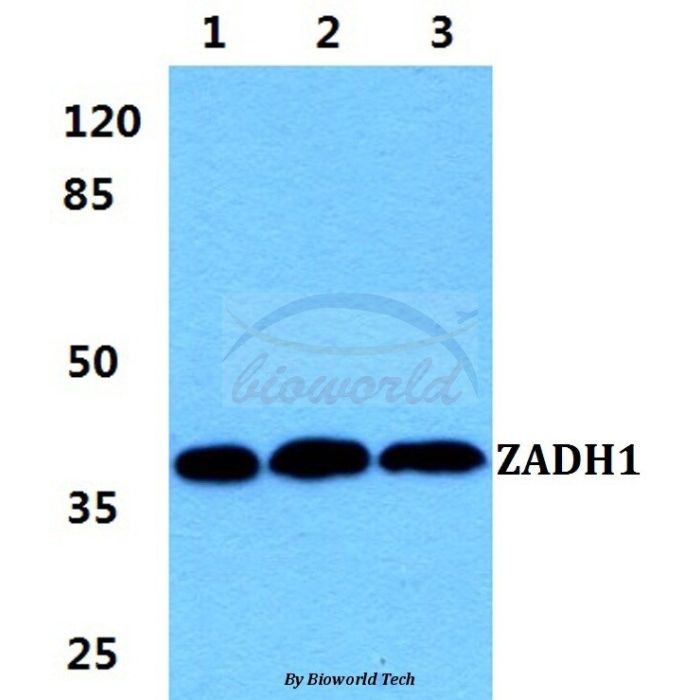
ZADH1 polyclonal, anti-human, mouse, rat
€305.00
In stock
SKU
BS5987
Background:
ZADH1 (zinc binding alcohol dehydrogenase,domain containing 1), also known as PTGR2 (prostaglandin reductase 2), PGR2 or 15-oxoprostaglandin 13-reductase, is a 351 amino acid cytoplasmic protein that belongs to the NADP-dependent oxidoreductase L4BD family. Functioning as s a 15-oxoprostaglandin 13-reductase, ZADH1 catalyzes the conversion of 15-keto-prostaglandin E2 to 15-keto-13,14-dihydro-prostaglandin E2 in a NADPH-dependent manner. ZADH1 overexpression has been found to repress PPARγ transcriptional activity and adipocyte differentiation. Widely expressed, ZADH1 is found at highest levels in heart, kidney, liver, pancreas and prostate, with moderate levels found in brain, small intestine, lung, testis and skeletal muscle. ZADH1 exists as a monomer, utilizes NADPH as a cofactor, and undergoes alternative splicing to produce two isoforms that are encoded by a gene located on human chromosome 14q24.3.
Alternative Name:
Prostaglandin reductase 2, PRG-2, PRG2, 15-oxoprostaglandin 13-reductase, Zinc-binding alcohol dehydrogenase domain-containing protein 1, PTGR2, ZADH1
Application Dilution: WB: 1:500~1:1000, IHC: 1:50~1:200, ICC: 1:50~1:200
Specificity: ZADH1 polyclonal antibody detects endogenous levels of ZADH1 protein.
Immunogen:
Synthetic peptide, corresponding to amino acids 228-273 of Human ZADH1.
MW: ~ 38 kDa
Swis Prot.: Q8N8N7
Purification & Purity:
The antibody was affinity-purified from rabbit antiserum by affinity-chromatography using epitope-specific immunogen and the purity is > 95% (by SDS-PAGE).
Format:
1 mg/ml in Phosphate buffered saline (PBS) with 0.05% sodium azide, approx. pH 7.2.
Storage:
Store at 4°C short term. Aliquot and store at -20°C long term. Avoid freeze-thaw cycles.
For research use only, not for use in diagnostic procedure.
ZADH1 (zinc binding alcohol dehydrogenase,domain containing 1), also known as PTGR2 (prostaglandin reductase 2), PGR2 or 15-oxoprostaglandin 13-reductase, is a 351 amino acid cytoplasmic protein that belongs to the NADP-dependent oxidoreductase L4BD family. Functioning as s a 15-oxoprostaglandin 13-reductase, ZADH1 catalyzes the conversion of 15-keto-prostaglandin E2 to 15-keto-13,14-dihydro-prostaglandin E2 in a NADPH-dependent manner. ZADH1 overexpression has been found to repress PPARγ transcriptional activity and adipocyte differentiation. Widely expressed, ZADH1 is found at highest levels in heart, kidney, liver, pancreas and prostate, with moderate levels found in brain, small intestine, lung, testis and skeletal muscle. ZADH1 exists as a monomer, utilizes NADPH as a cofactor, and undergoes alternative splicing to produce two isoforms that are encoded by a gene located on human chromosome 14q24.3.
Alternative Name:
Prostaglandin reductase 2, PRG-2, PRG2, 15-oxoprostaglandin 13-reductase, Zinc-binding alcohol dehydrogenase domain-containing protein 1, PTGR2, ZADH1
Application Dilution: WB: 1:500~1:1000, IHC: 1:50~1:200, ICC: 1:50~1:200
Specificity: ZADH1 polyclonal antibody detects endogenous levels of ZADH1 protein.
Immunogen:
Synthetic peptide, corresponding to amino acids 228-273 of Human ZADH1.
MW: ~ 38 kDa
Swis Prot.: Q8N8N7
Purification & Purity:
The antibody was affinity-purified from rabbit antiserum by affinity-chromatography using epitope-specific immunogen and the purity is > 95% (by SDS-PAGE).
Format:
1 mg/ml in Phosphate buffered saline (PBS) with 0.05% sodium azide, approx. pH 7.2.
Storage:
Store at 4°C short term. Aliquot and store at -20°C long term. Avoid freeze-thaw cycles.
For research use only, not for use in diagnostic procedure.
| Is Featured? | No |
|---|
Write Your Own Review