
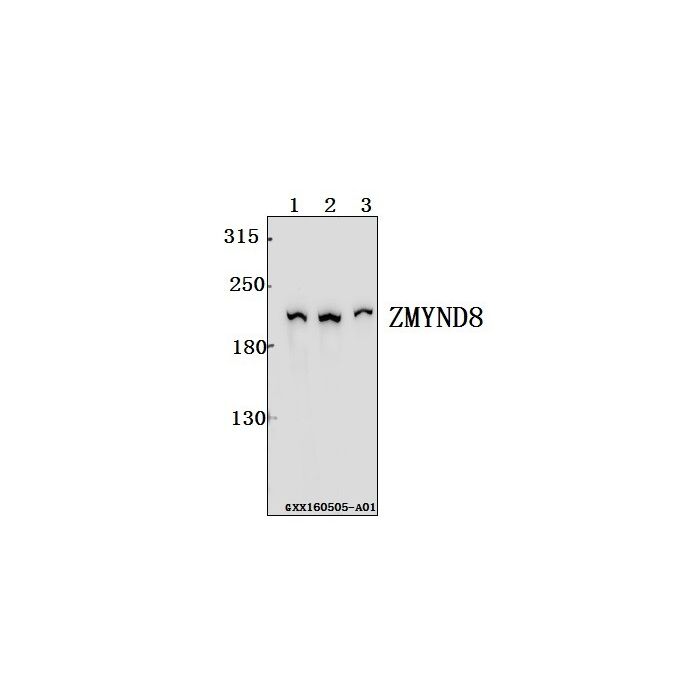
ZMYND8 polyclonal, anti-human, mouse, rat
€305.00
In stock
SKU
BS61552
Background:
Members of the protein kinase C (PKC) family play a key regulatory role in a variety of cellular functions including cell growth and differentiation, gene expression, hormone secretion and membrane function. Receptor for activated C kinases, termed RACKs, are intracellular receptors for activated PKC that serve as anchors and may be involved in the activation-induced translocation of PKC. RACK7 (receptor for activated C kinase 7), also known as ZMYND8 (zinc finger MYND domain-containing protein 8), PRKCBP1 (protein kinase C (PKC)-binding protein 1) or PRO2893, is a widely expressed protein with predominant expression in pancreas, lung, placenta and brain. RACK7 contains one bromodomain, one PHD-type zinc finger, one MYND-type zinc finger and one PWWP domain. Via its C-terminus, RACK7 interacts with PKC ∫ and is believed to play a role in PKC signaling and function as a transcription regulator. In response to DNA damage, RACK7 is phosphorylated by ATM or ATR. In addition, multiple isoforms exist for RACK7.
Alternative Name:
Protein kinase C-binding protein 1, Cutaneous T-cell lymphoma-associated antigen se14-3, Rack7, Zinc finger MYND domain-containing protein 8
Application Dilution: WB: 1:500~1:1000
Specificity: ZMYND8 polyclonal antibody detects endogenous levels of ZMYND8 protein.
Immunogen:
Synthetic peptide, corresponding to amino acids 586-630 of Human ZMYND8
MW: ~ 190 kDa
Swis Prot.: Q9ULU4
Purification & Purity:
The antibody was affinity-purified from rabbit antiserum by affinity-chromatography using epitope-specific immunogen and the purity is > 95% (by SDS-PAGE)
Format:
1 mg/ml in Phosphate buffered saline (PBS) with 0.05% sodium azide, approx. pH 7.3.
Storage:
Store at 4°C short term. Aliquot and store at -20°C long term. Avoid freeze-thaw cycles.
For research use only, not for use in diagnostic procedure.
Members of the protein kinase C (PKC) family play a key regulatory role in a variety of cellular functions including cell growth and differentiation, gene expression, hormone secretion and membrane function. Receptor for activated C kinases, termed RACKs, are intracellular receptors for activated PKC that serve as anchors and may be involved in the activation-induced translocation of PKC. RACK7 (receptor for activated C kinase 7), also known as ZMYND8 (zinc finger MYND domain-containing protein 8), PRKCBP1 (protein kinase C (PKC)-binding protein 1) or PRO2893, is a widely expressed protein with predominant expression in pancreas, lung, placenta and brain. RACK7 contains one bromodomain, one PHD-type zinc finger, one MYND-type zinc finger and one PWWP domain. Via its C-terminus, RACK7 interacts with PKC ∫ and is believed to play a role in PKC signaling and function as a transcription regulator. In response to DNA damage, RACK7 is phosphorylated by ATM or ATR. In addition, multiple isoforms exist for RACK7.
Alternative Name:
Protein kinase C-binding protein 1, Cutaneous T-cell lymphoma-associated antigen se14-3, Rack7, Zinc finger MYND domain-containing protein 8
Application Dilution: WB: 1:500~1:1000
Specificity: ZMYND8 polyclonal antibody detects endogenous levels of ZMYND8 protein.
Immunogen:
Synthetic peptide, corresponding to amino acids 586-630 of Human ZMYND8
MW: ~ 190 kDa
Swis Prot.: Q9ULU4
Purification & Purity:
The antibody was affinity-purified from rabbit antiserum by affinity-chromatography using epitope-specific immunogen and the purity is > 95% (by SDS-PAGE)
Format:
1 mg/ml in Phosphate buffered saline (PBS) with 0.05% sodium azide, approx. pH 7.3.
Storage:
Store at 4°C short term. Aliquot and store at -20°C long term. Avoid freeze-thaw cycles.
For research use only, not for use in diagnostic procedure.
| Is Featured? | No |
|---|
Write Your Own Review