
ZMYND8 (Q608) polyclonal, anti-human, mouse, rat
€305.00
In stock
SKU
BS2509
Catalog Number: BS2509
Size: 100 µl
Other Size: 50 µl
Isotype: rabbit IgG
Applications: WB
Questions? Contact us!
Size: 100 µl
Other Size: 50 µl
Isotype: rabbit IgG
Applications: WB
Questions? Contact us!
Background:
Zinc finger MYND domain-containing protein 8 (ZMYND8), also referred to as receptor for activated C-kinase 7 (Rack7) and protein kinase C-binding protein 1 (PRKCBP1), is a DNA damage response protein and a transcriptional regulator that is a close homolog of ZMYND11 (BS69). ZMYND8 binds to H3K36me2 and H4K16ac, two histone marks associated with active transcription. This protein is targeted to sites of DNA damage within actively transcribed genes, and recruits the H3K4me3-specific histone demethylase KDM5A/JARID1A and nucleosome remodeling and histone deacetylation (NuRD) complex. Together, these protein complexes mediate transcriptional repression and allow for subsequent double-strand break repair via homologous recombination. ZMYND8 contains a bromodomain and a PWWP domain near its N-terminus, and a MYND domain towards the C-terminus, the latter of which mediates interaction with the NuRD complex. ZMYND8 also functions to recruit the H3K4me3-specific histone demethylase KDM5C/JARID1C to enhancer and super-enhancer regions, and functions as a negative regulator of gene expression. ZMYND8 and JARID1C are both putative tumor suppressor proteins, and knockdown of either of these proteins leads to derepression of S100 oncogenes. ZMYND8 expression is altered in breast and cervical cancer, and has been found to be translocated with RELA in at least one patient with acute erythroid leukemia. Knock-down of ZMYND8 expression in breast cancer cell lines increases anchorage-independent cell growth, cell migration and invasion, and tumor growth in mouse xenograft models.
Alternative Name:
Protein kinase C-binding protein 1, Cutaneous T-cell lymphoma-associated antigen se14-3, CTCL-associated antigen se14-3, Rack7, Zinc finger MYND domain-containing protein 8, ZMYND8, KIAA1125, PRKCBP1, RACK7
Application Dilution:
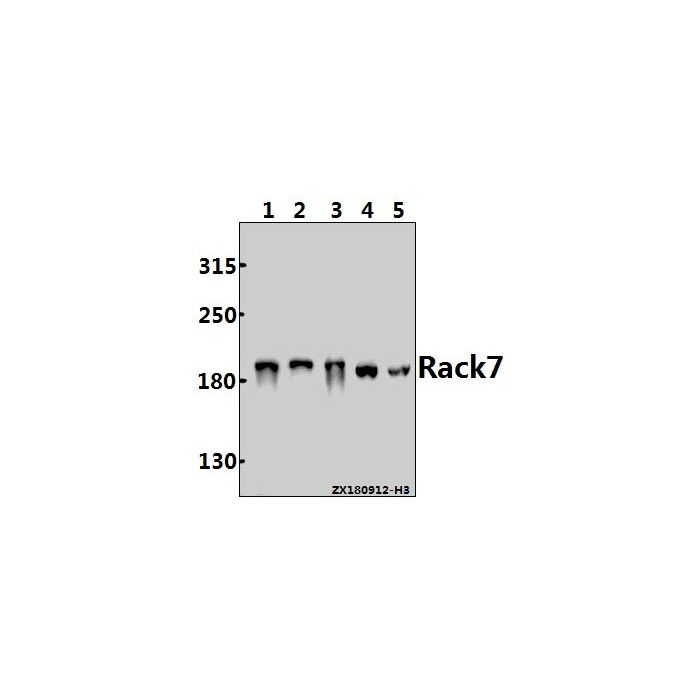
WB: 1:500~1:1000
Specificity: Rack7 (Q608) polyclonal antibody detects endogenous levels of Rack7 protein.
Immunogen:
Synthetic peptide, corresponding to amino acids 578-538 of Human Rack7.
MW: ~ 180 kDa
Swiss-Prot: Q9ULU4
Purification & Purity:
The antibody was affinity-purified from rabbit antiserum by affinity-chromatography using epitope-specific immunogen and the purity is > 95% (by SDS-PAGE).
Format:
Rabbit IgG, 1mg/ml in PBS with 0.02% sodium azide, 50% glycerol, pH7.2
Storage:
Store at 4°C short term. Aliquot and store at -20°C long term. Avoid freeze-thaw cycles.
For research use only, not for use in diagnostic procedure.
Zinc finger MYND domain-containing protein 8 (ZMYND8), also referred to as receptor for activated C-kinase 7 (Rack7) and protein kinase C-binding protein 1 (PRKCBP1), is a DNA damage response protein and a transcriptional regulator that is a close homolog of ZMYND11 (BS69). ZMYND8 binds to H3K36me2 and H4K16ac, two histone marks associated with active transcription. This protein is targeted to sites of DNA damage within actively transcribed genes, and recruits the H3K4me3-specific histone demethylase KDM5A/JARID1A and nucleosome remodeling and histone deacetylation (NuRD) complex. Together, these protein complexes mediate transcriptional repression and allow for subsequent double-strand break repair via homologous recombination. ZMYND8 contains a bromodomain and a PWWP domain near its N-terminus, and a MYND domain towards the C-terminus, the latter of which mediates interaction with the NuRD complex. ZMYND8 also functions to recruit the H3K4me3-specific histone demethylase KDM5C/JARID1C to enhancer and super-enhancer regions, and functions as a negative regulator of gene expression. ZMYND8 and JARID1C are both putative tumor suppressor proteins, and knockdown of either of these proteins leads to derepression of S100 oncogenes. ZMYND8 expression is altered in breast and cervical cancer, and has been found to be translocated with RELA in at least one patient with acute erythroid leukemia. Knock-down of ZMYND8 expression in breast cancer cell lines increases anchorage-independent cell growth, cell migration and invasion, and tumor growth in mouse xenograft models.
Alternative Name:
Protein kinase C-binding protein 1, Cutaneous T-cell lymphoma-associated antigen se14-3, CTCL-associated antigen se14-3, Rack7, Zinc finger MYND domain-containing protein 8, ZMYND8, KIAA1125, PRKCBP1, RACK7
Application Dilution:
WB: 1:500~1:1000
Specificity: Rack7 (Q608) polyclonal antibody detects endogenous levels of Rack7 protein.
Immunogen:
Synthetic peptide, corresponding to amino acids 578-538 of Human Rack7.
MW: ~ 180 kDa
Swiss-Prot: Q9ULU4
Purification & Purity:
The antibody was affinity-purified from rabbit antiserum by affinity-chromatography using epitope-specific immunogen and the purity is > 95% (by SDS-PAGE).
Format:
Rabbit IgG, 1mg/ml in PBS with 0.02% sodium azide, 50% glycerol, pH7.2
Storage:
Store at 4°C short term. Aliquot and store at -20°C long term. Avoid freeze-thaw cycles.
For research use only, not for use in diagnostic procedure.
| Is Featured? | No |
|---|
Write Your Own Review