
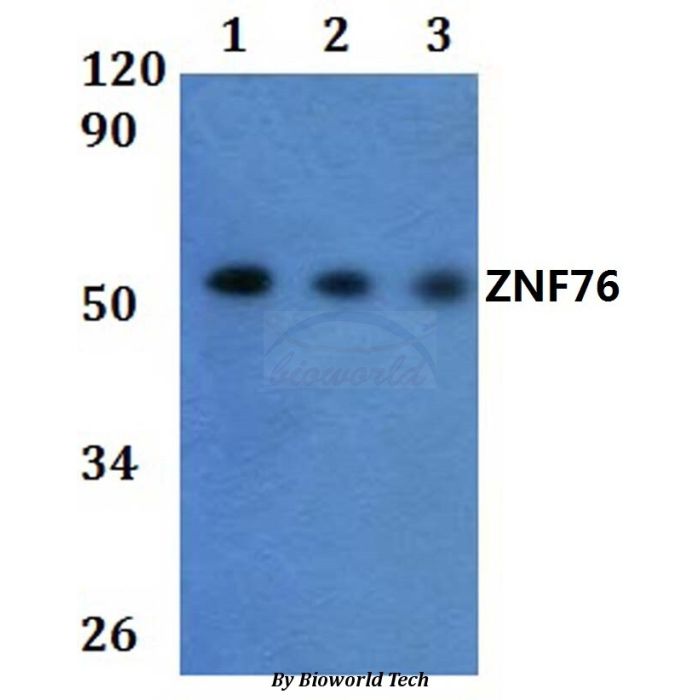
ZNF76 polyclonal, anti-human, mouse, rat
€305.00
In stock
SKU
BS61023
Background:
ZNF76, also known as ZNF523 or Zfp523, is a transcriptional repressor expressed in the testis. It is the human homolog of the Xenopus Staf protein (selenocysteine tRNA gene transcription-activating factor) known to regulate the genes encoding small nuclear RNA and selenocysteine tRNA. ZNF76 localizes to the nucleus and exerts an inhibitory function on p53-mediated transactivation. ZNF76 specifically targets TFIID (TATA-binding protein). The interaction with TFIID occurs through both its N and C termini. The transcriptional repression activity of ZNF76 is predominantly regulated by lysine modifications, acetylation and sumoylation. ZNF76 is sumoylated by PIAS 1 and is acetylated by p300. Acetylation leads to the loss of sumoylation and a weakened TFIID interaction. ZNF76 can be deacetylated by HDAC1. In addition to lysine modifications, ZNF76 activity is also controlled by splice variants. Two isoforms exist due to alternative splicing. These isoforms vary in their ability to interact with TFIID.
Alternative Name:
Zinc finger protein 76, Zinc finger protein 523, ZNF76, D6S229E, ZNF523
Application Dilution: WB: 1:500~1:1000
Specificity: ZNF76 polyclonal antibody detects endogenous levels of ZNF76 protein.
Immunogen:
A synthetic peptide corresponding to residues in Human ZNF76.
MW: ~ 56 kDa
Swis Prot.: P36508
Purification & Purity:
The antibody was affinity-purified from rabbit antiserum by affinity-chromatography using epitope-specific immunogen and the purity is > 95% (by SDS-PAGE).
Format:
1 mg/ml in Phosphate buffered saline (PBS) with 0.05% sodium azide, approx. pH 7.3.
Storage:
Store at 4°C short term. Aliquot and store at -20°C long term. Avoid freeze-thaw cycles.
For research use only, not for use in diagnostic procedure.
ZNF76, also known as ZNF523 or Zfp523, is a transcriptional repressor expressed in the testis. It is the human homolog of the Xenopus Staf protein (selenocysteine tRNA gene transcription-activating factor) known to regulate the genes encoding small nuclear RNA and selenocysteine tRNA. ZNF76 localizes to the nucleus and exerts an inhibitory function on p53-mediated transactivation. ZNF76 specifically targets TFIID (TATA-binding protein). The interaction with TFIID occurs through both its N and C termini. The transcriptional repression activity of ZNF76 is predominantly regulated by lysine modifications, acetylation and sumoylation. ZNF76 is sumoylated by PIAS 1 and is acetylated by p300. Acetylation leads to the loss of sumoylation and a weakened TFIID interaction. ZNF76 can be deacetylated by HDAC1. In addition to lysine modifications, ZNF76 activity is also controlled by splice variants. Two isoforms exist due to alternative splicing. These isoforms vary in their ability to interact with TFIID.
Alternative Name:
Zinc finger protein 76, Zinc finger protein 523, ZNF76, D6S229E, ZNF523
Application Dilution: WB: 1:500~1:1000
Specificity: ZNF76 polyclonal antibody detects endogenous levels of ZNF76 protein.
Immunogen:
A synthetic peptide corresponding to residues in Human ZNF76.
MW: ~ 56 kDa
Swis Prot.: P36508
Purification & Purity:
The antibody was affinity-purified from rabbit antiserum by affinity-chromatography using epitope-specific immunogen and the purity is > 95% (by SDS-PAGE).
Format:
1 mg/ml in Phosphate buffered saline (PBS) with 0.05% sodium azide, approx. pH 7.3.
Storage:
Store at 4°C short term. Aliquot and store at -20°C long term. Avoid freeze-thaw cycles.
For research use only, not for use in diagnostic procedure.
| Is Featured? | No |
|---|
Write Your Own Review